

Electronic-warfare education becomes more useful when the trainee can follow the complete chain: from a real radar measurement, through a controlled deceptive effect, to ECCM analysis and finally to the question of whether an AI model can recognise and interpret a disturbed radar scene.
The missing link in EW education is the signal itself
Electronic warfare is often taught as a sequence of concepts: jamming, deception, counter-countermeasures and signal processing. Yet the decisive learning step comes when an officer or engineer has to interpret what a radar actually measures. A useful laboratory therefore needs more than a simulator and more than a software demonstration. It needs a path from physical RF effects to analysis.
SkyRadar combines real radar hardware, an RGPO-oriented SkyRadar Active Target, classical ECCM processing in FreeScopes ECCM I and FreeScopes ECCM II, and AI-based radar analysis in FreeScopes AI I and FreeScopes AI II in one integrated electronic-warfare training architecture.
This creates a learning chain rather than a set of isolated products: measure a real radar return, introduce a controlled deception effect, detect and analyse it with classical processing, then use the resulting radar and simulator data to teach machine-learning methods and jamming-aware perception.
1. Start with a real radar — then disturb what it sees
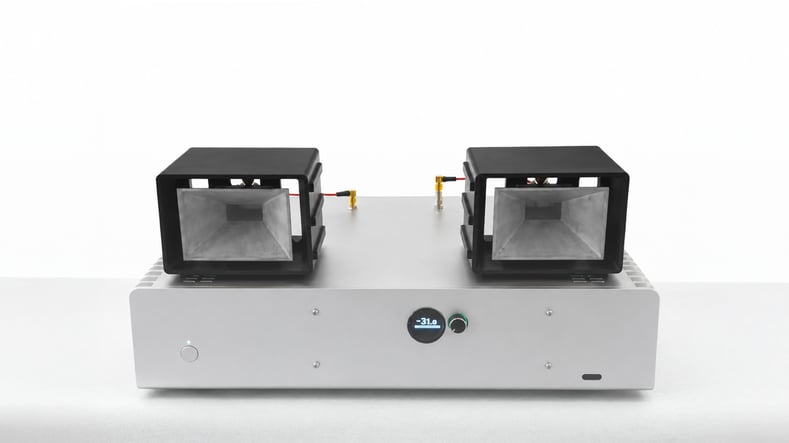
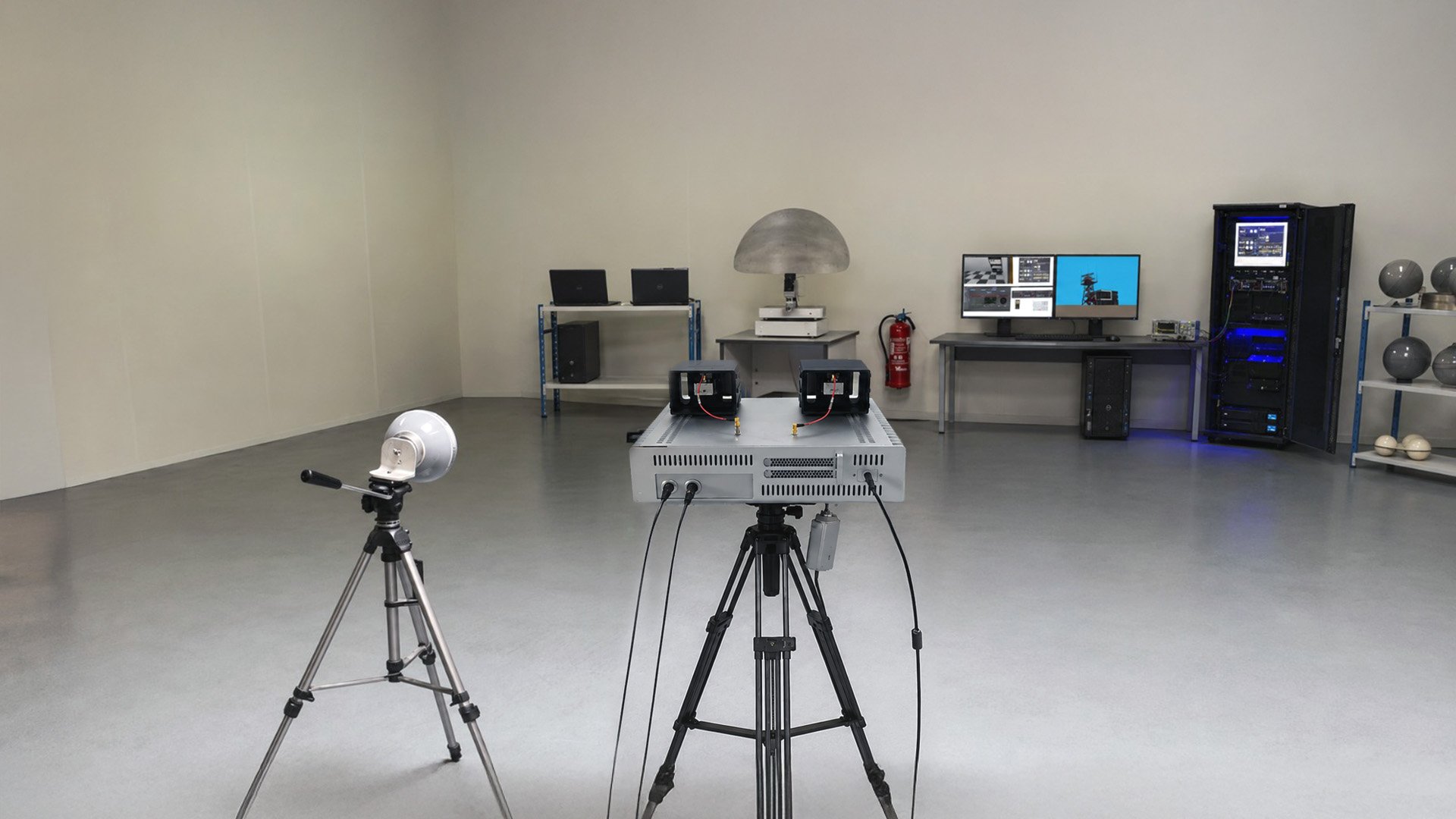
The exercise begins with the NextGen 8 GHz Pulse Radar. The trainee establishes a baseline target return and observes the radar data before any disturbance is introduced. The Active Target then adds a physical, RGPO-oriented training effect in the short-range laboratory environment.
The SkyRadar Active Target is designed for practical ECCM training with the NextGen 8 GHz radar. Its role is not to reproduce every possible electronic-attack scenario. Its value is more specific: it gives trainees a real hardware effect that can be measured, compared with the baseline and analysed in the same training environment.
That distinction is important. Simulation provides repeatability and known scenario parameters. Physical hardware introduces the sensor measurement itself. An academy can therefore compare what should happen in a controlled scenario with what the radar actually reports when a deceptive effect is present.
2. ECCM I: recognise the disturbance and build a response
FreeScopes ECCM I is the trainee-side environment for first-level disturbance and deception analysis. The instructor can control the common ECM scenario while each student independently builds and evaluates a FreeScopes processing chain.
Its training scope includes spot, sector and barrage jamming concepts, range deception, RGPO and RGPI, and static active-target or static range-deception effects. Confirmed processing blocks include Barrage Jamming Detection, Sector Jamming Detection for pulse and FMCW contexts, Phase Shift Detection, RGPO Detection and Detect Static Range Deception. Trainees can compare these with familiar radar-processing methods such as MTI, clutter maps, MTD, Kalman filtering, Doppler phase-shift processing, and plots and tracks.
The teaching question changes from “What is RGPO?” to “How do I recognise it in this data, and which processing chain gives me evidence that the scene is being manipulated?”
3. ECCM II: move from range deception to angle and velocity
FreeScopes ECCM II extends the analysis into more advanced deception. Its confirmed trainee-side methods include SASP Deception Detection, AGPO Detection and VGPO Detection.
The emphasis is on interpreting manipulated target behaviour rather than merely displaying a predefined attack. Angle Gate Pull-Off and Velocity Gate Pull-Off introduce different questions about the credibility of a radar track, while SASP-oriented detection adds a more advanced statistical and adaptive signal-processing perspective where included in the build.
SkySim remains complementary at this stage: the simulator can generate advanced scenarios, while FreeScopes ECCM II remains the student's detection and analysis workspace. This separation lets an academy teach both sides of the problem without confusing scenario generation with the trainee's analytical task.
4. AI I: turn radar measurements into learning data
FreeScopes AI I introduces the machine-learning layer. Its confirmed scope is classification and anomaly detection rather than jamming detection or tracking.
Students build neural-network workflows visually: they select and label data, define input and network layers, train and evaluate models, save trained models and load them again. They can compare shallow and deeper architectures, work with Dense and Conv1D structures, use regularisation and pooling, and interpret accuracy, validation accuracy, loss, convergence and overfitting.
For an EW curriculum, this is useful because the data now has a provenance the trainee understands. It can come from radar measurements, simulator exercises or replayed training datasets. The student has already seen how disturbance changes the signal before asking a neural network to find structure in that data.
5. AI II: ask whether perception remains reliable under jamming
FreeScopes AI II moves toward robust radar and simulator-data perception with jamming awareness. The training focus includes frame- and sequence-level interpretation, temporal consistency and scene-reliability estimation.
A particularly useful teaching distinction is the difference between simulated and real measurements. In simulation, the system can provide full ground-truth state information and explicitly injected jamming parameters. With real radar data, there is no equivalent omniscient truth source. Training must instead work with observation-based or derived annotations such as detection outputs, track consistency and jamming-event labels.
This gives military AI training a practical question that is often absent from generic machine-learning courses: how much confidence should be placed in a model when the sensor scene itself may be degraded or deliberately deceptive?
One exercise, five layers of understanding
Consider a single academy exercise. The class first observes a target with the NextGen 8 GHz radar and records a baseline. A controlled RGPO-oriented Active Target scenario is then introduced. Students examine how the return changes. In ECCM I they identify range-deception indicators and compare processing chains. ECCM II extends the discussion toward more advanced deception detection. The resulting live, recorded or replayed data can then become material for AI training: AI I teaches how to structure and evaluate classification or anomaly-detection models; AI II asks whether radar perception remains reliable in jamming-related conditions.
|
REAL RF Measure |
Introduce deception |
Detect & analyse |
Advanced deception |
Learn & assess |
The SkyRadar EW training architecture at a glance
SkyRadar Active Target: Physical, RGPO-oriented training hardware used with the NextGen 8 GHz Pulse Radar to introduce controlled real-hardware deception effects.
FreeScopes ECCM I: Student-side detection and analysis of jamming, range deception and first-level ECCM processing, including RGPO-oriented exercises.
FreeScopes ECCM II: Advanced trainee-side deception analysis, including confirmed SASP, AGPO and VGPO detection methods.
FreeScopes AI I: Foundational neural-network training for radar classification and anomaly detection, including data preparation, model construction, training and evaluation.
FreeScopes AI II: Advanced radar-perception training with jamming awareness, temporal interpretation and scene-reliability concepts.
What this changes for a military academy
For a military academy, the central question is not how many individual software functions can be listed. It is whether students can progress through a coherent technical curriculum: from radar physics and real measurements, through electronic attack and classical ECCM, to the limitations and possibilities of AI-based radar perception.
The SkyRadar architecture is designed around that progression. Real radar hardware provides the measurement. The Active Target introduces a physical RGPO-oriented training effect. FreeScopes ECCM I and II provide independent student analysis. AI I and AI II then allow the same broader radar-data environment to support machine-learning education from introductory classification to jamming-aware perception.
This is materially different from teaching electronic warfare only through slides, fixed recordings or an isolated simulator. The trainee can see where the data comes from, how a deceptive effect changes it, how classical processing responds, and why an AI model must be evaluated against the quality and trustworthiness of its inputs.
A technically defensible market claim
SkyRadar can substantiate the integration described here from its controlled product architecture: real radar hardware, an RGPO-oriented Active Target, FreeScopes ECCM I and II, and FreeScopes AI I and II form one hands-on training path. A categorical claim that this is the only such system worldwide would require separate competitive evidence. For decision-makers, the more relevant point is the architecture itself: the same laboratory can connect physical radar effects, classical ECCM reasoning and AI-based analysis without presenting the training environment as an operational weapon, fire-control or certified combat system.
From understanding interference to understanding trust
Modern EW education is increasingly about trust in observations. A radar return may be weak, cluttered, displaced or deliberately deceptive. A classical processing chain may react differently from an AI model. A simulator may know the exact truth; a real sensor does not.
A laboratory that begins with a real echo and follows it through electronic attack, ECCM and AI gives trainees a disciplined way to ask the questions that matter: What changed in the signal? How do I know it is deception? Which processing method is robust? What labels can I trust? And when an AI model produces a confident answer, what evidence supports that confidence?
That is the purpose of connecting the SkyRadar Active Target with FreeScopes ECCM I, ECCM II, AI I and AI II: to make the complete reasoning chain observable, repeatable and hands-on.
Stay connected with our ongoing publications on Electronic Warfare and Radar Technology.