


Artificial intelligence is becoming increasingly relevant in radar, electronic warfare, and spectrum analysis. Machine learning methods can support pattern recognition, anomaly detection, signal classification, and decision support in complex electromagnetic environments.
However, in defence and safety-critical contexts, AI cannot be treated as a black box. Engineers and operators must understand how a model is trained, what data it uses, how it behaves under changing signal conditions, and where its limits are.
This is why explainable AI is becoming an important part of radar and electronic warfare training. The question is not whether AI can produce an output, but whether users can understand, validate, and trust the reasoning behind that output.
SkyRadar’s approach follows this principle. AI is used to support adaptive decision-making under uncertainty, not to replace engineering judgement. This is especially important in radar and EW environments, where signal behaviour, interference, deception, clutter, and changing spectrum conditions must remain visible and understandable to the user.
Through environments such as FreeScopes AI, FreeScopes, and SkySim, users can explore artificial intelligence in connection with radar signals, simulated scenarios, and practical signal-processing workflows.
As Eurosatory 2026 approaches, explainable AI is becoming part of a larger defence training discussion: how to prepare engineers, analysts, and operators to work with adaptive radar and electronic warfare technologies.
|
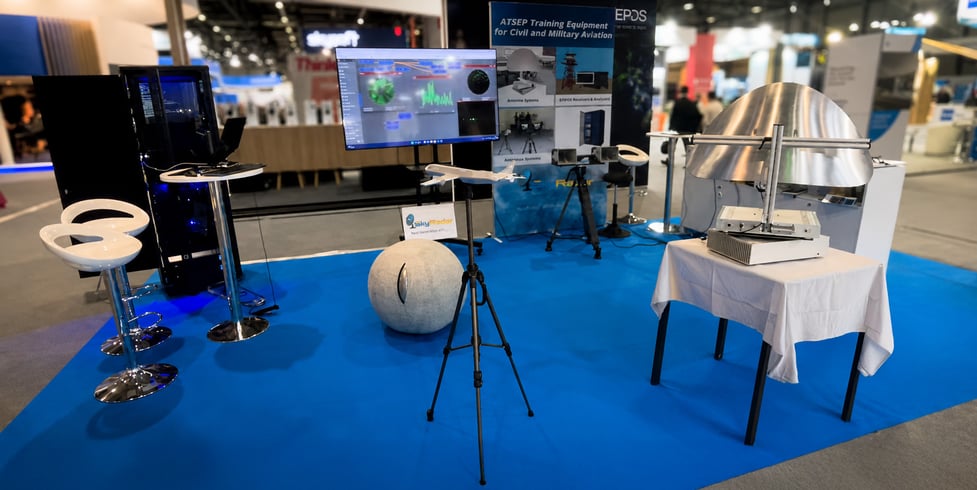
Luxembourg Pavilion |
AI as Support, Not Replacement
In radar and electronic warfare, AI should not be understood as a replacement for engineering judgement. Its role is to support interpretation, identify patterns, and assist decision-making under uncertainty.
A radar system operating in a contested electromagnetic environment may encounter interference, deception, clutter, multiple emitters, or unexpected signal behaviour. In such situations, AI can help identify patterns that may be difficult to see manually.
But the final value of AI depends on trust. If users cannot understand the training process, the input data, or the decision logic, the system becomes difficult to validate.
This is especially important for military academies, defence research organisations, ATSEP training centres, and universities preparing engineers for advanced radar and spectrum environments.
Why Radar Is a Strong Training Domain for AI
Radar signals provide a practical and technically meaningful environment for AI training. They include measurable patterns, changing signal conditions, target behaviour, noise, clutter, Doppler effects, and interference.
This makes radar a useful domain for teaching machine learning concepts in a way that is connected to real engineering problems.
Instead of learning AI only through generic datasets, students and engineers can examine how machine learning methods apply to radar signals, spectrum data, or simulated electronic warfare scenarios.
This helps build a more realistic understanding of AI. Users do not simply train a model. They must understand how data is prepared, how labels are defined, how performance is evaluated, and how the model behaves when the environment changes.
FreeScopes AI and Visual Learning
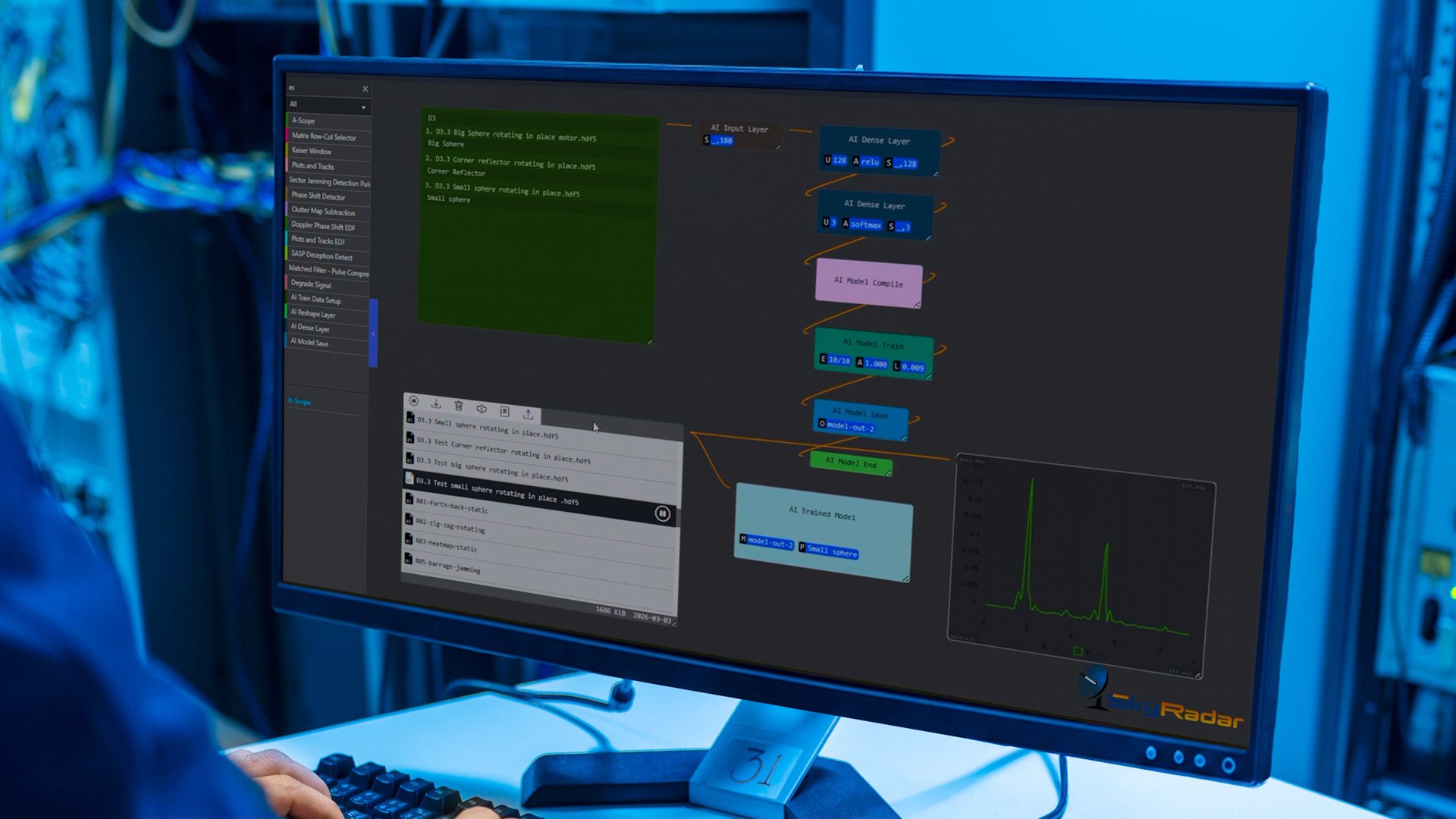
SkyRadar’s FreeScopes AI environment introduces artificial intelligence through a visual, block-based approach. Users can construct neural-network workflows without needing to start from programming syntax.
This makes it easier to focus on the logic of machine learning:
- data selection and labelling
- network structure
- model training
- evaluation and validation
- saving and loading models
- later experimentation on radar or spectrum data
The purpose is not to simplify AI into a marketing feature. The purpose is to make the learning process transparent.
Users can explore how different model structures influence results, how training data affects performance, and how AI methods may support radar or spectrum analysis. This helps connect AI education with practical radar engineering.
From Signal Data to Operator Trust
In radar and EW environments, explainability is not optional. A model may identify a signal pattern or classify a disturbance, but engineers still need to understand why the result matters.
This is especially true in electronic warfare training. Signal environments may involve jamming, deception, congestion, or anomalous behaviour. In such cases, AI-supported analysis should help users ask better questions, not hide the signal behaviour behind automated outputs.
Training environments must therefore show the relationship between the input data, the processing workflow, and the resulting interpretation.
SkyRadar’s approach supports this by combining radar measurements, simulation, signal processing, and AI training within a practical environment. This allows users to connect machine learning concepts with observable signal behaviour.
AI, Cognitive Radar and Adaptive Behaviour
Cognitive radar and cognitive electronic warfare depend on the ability to sense, evaluate, and adapt. AI can support this loop, but it must remain understandable.
A cognitive system that adapts without explanation may be difficult to trust. A training environment that allows users to study adaptation, signal behaviour, and AI-supported analysis helps develop the engineering judgement needed for future systems.
This is why AI training in radar and EW should be linked to simulation, real signal data, and operator-centred interpretation.
When users can observe the signal, adjust the processing chain, train a model, and compare the result with known scenarios, AI becomes part of the learning process rather than a hidden layer of automation.
Simulation and Scenario-Based AI Training
Radar and electronic warfare training becomes more meaningful when AI can be tested against controlled scenarios. Simulation environments allow users to repeat exercises, change assumptions, compare outcomes, and study how models behave when signal conditions shift.
For example, trainees may examine how a model responds to clean radar data, disturbed signal environments, jamming effects, or changing target behaviour. This makes it possible to discuss not only whether the AI model produced a result, but whether that result remains reliable under pressure.
By combining radar measurements, simulated spectrum activity, and visual AI workflows, SkyRadar supports a training approach where AI is connected to signal behaviour, not separated from it.
Relevance for Eurosatory 2026
Eurosatory 2026 will highlight technologies connected to defence readiness, electronic warfare, sensing, autonomy, and spectrum operations.
In this context, explainable AI is not only a software topic. It is part of the larger question of how defence organisations prepare people to work with adaptive technologies.
SkyRadar’s work in radar simulation, FreeScopes AI, and EW training environments addresses this training layer. It helps users understand how AI can support radar and spectrum analysis while maintaining the transparency required for trust.
Meet SkyRadar at Eurosatory 2026
SkyRadar will be present at Eurosatory 2026 in Paris from 15–19 June 2026.
Visitors can meet the SkyRadar team at:
|
Luxembourg Pavilion |

SkyRadar will present technologies for cognitive radar, ECCM training, electronic warfare simulation, and AI-supported radar signal analysis.
In a defence environment where systems must adapt to changing spectrum conditions, explainable AI helps ensure that adaptive behaviour can be studied, validated, and trusted by the people who use it.
Write us to Make an Appointment with our Team

Eurosatory 2026 / 15–19 June 2026 / Paris / Luxembourg Pavilion – Hall 5a – Stand H190
How to get there? | Write us to arrange a meeting: info@SkyRadar.com