

This article introduces electronic counter-countermeasures explained as a layered ECCM stack, from waveform agility to multi-static geometry. It further describes SkyRadar trains these capabilities.
Electronic attack has become a persistent feature of contemporary air and air-defence environments. Noise jamming, coherent deception, sidelobe exploitation, and increasingly sophisticated gate pull-off techniques are no longer exceptional cases but design assumptions. At the same time, the proliferation of small unmanned aerial systems, operating individually or in swarms, places additional stress on radar detection and tracking chains.
In this context, Electronic Counter-Countermeasures (ECCM) can no longer be understood as a single algorithm or isolated feature. They must instead be viewed as an integrated system stack, spanning waveform design, antenna behavior, geometry, and higher-level tracking and decision logic.
From isolated techniques to layered resilience
Traditional descriptions of ECCM often focus on individual measures: frequency agility, sidelobe blanking, or specific counter-deception filters. While each remains relevant, their effectiveness increasingly depends on how they interact across system layers.
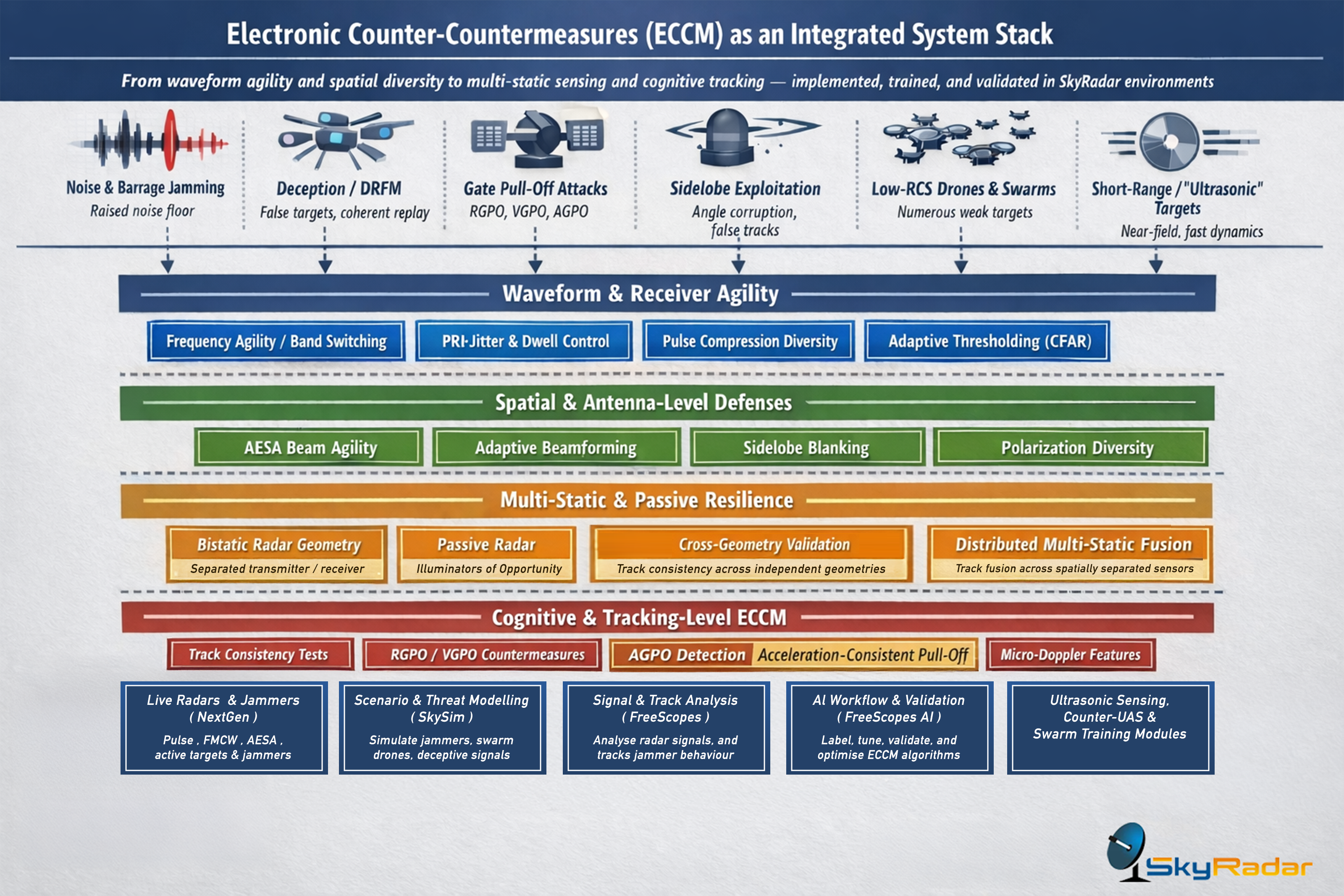
A modern ECCM stack can be understood as four interdependent domains.
Waveform and receiver agility
At the foundation of the stack lies waveform and receiver behavior. Frequency agility, PRI jitter, dwell control, pulse compression diversity, and adaptive thresholding shape the radar’s temporal and spectral footprint.
These mechanisms directly influence predictability. By varying transmission timing and illumination patterns, they reduce the ability of jammers to synchronise, replay, or coherently manipulate radar returns. In environments characterized by barrage noise or DRFM-based deception, such agility is often the first line of defense.
Spatial and antenna-level defense
Above the waveform layer, antenna behavior introduces spatial selectivity. AESA beam agility, adaptive beamforming, sidelobe blanking, and polarisation diversity exploit the spatial domain to suppress interference and constrain deceptive signals.
These techniques do not merely improve signal quality; they complicate the attacker’s task by reducing exploitable sidelobes and by altering the spatial characteristics of the radar illumination in real time.
Multi-static and passive resilience
Geometric diversity beyond monostatic illumination
A further step in ECCM evolution is the deliberate use of geometry. Bistatic and multi-static radar configurations separate transmitters and receivers, introducing observation paths that differ fundamentally from monostatic illumination. Passive radar extends this concept by exploiting non-cooperative illuminators of opportunity, further diversifying the sensing geometry.
By observing targets under multiple bistatic angles, these configurations reduce reliance on a single illumination path and mitigate aspect-dependent effects such as shaping or specular scattering.
Cross-geometry validation
Cross-geometry validation operates at the tracking level. It assesses whether detections and tracks derived from different observation geometries—monostatic, bistatic, or passive—remain consistent in their kinematic evolution.
Inconsistent behavior across geometries is a strong indicator of coherent deception or gate pull-off activity, even when individual sensor tracks appear plausible in isolation.
Distributed fusion across sensors and geometries
Where consistency is established, distributed fusion combines measurements from spatially separated receivers and sensors into a coherent track picture. This fusion may involve strictly multi-static radar measurements, passive observations, or a broader set of parallel sensors.
From an ECCM standpoint, this approach reduces dependence on any single sensor or geometry and increases robustness against coherent deception techniques that cannot be sustained consistently across multiple observation paths.
Cognitive and tracking-level ECCM
At the highest level of the stack, ECCM becomes a question of interpretation and decision-making. Track consistency tests, countermeasures against RGPO and VGPO, emerging detection of acceleration-consistent pull-off (AGPO), and micro-Doppler feature extraction operate on tracks rather than raw signals.
These mechanisms are particularly relevant in scenarios involving low-RCS drones and swarms, where the challenge lies less in single detections than in maintaining stable, credible tracks over time.
ECCM as a training and qualification challenge
While these layers are well understood in principle, their effective use depends on human understanding as much as on system design. Operators, engineers, and analysts must be able to recognize the signatures of electronic attack, understand the limits of each ECCM layer, and interpret system behavior under stress.
This is where ECCM shifts from being a purely technical topic to a training and qualification problem.
SkyRadar’s role: training the ECCM stack
SkyRadar does not position itself as a radar hardware manufacturer. Its focus lies in training, simulation, and analysis infrastructures (radars, simulators, algorithms, train-the-trainer seminars) that allow ECCM concepts to be explored, stressed, and understood in a controlled manner.
Through scenario and threat modelling, signal and track analysis, and AI-supported validation workflows, SkyRadar enables users to train against realistic jamming, deception, drone, and swarm scenarios. Live radar and jammer inputs, simulated environments, and specialized modules—such as counter-UAS and ultrasonic sensing extensions—allow the full ECCM stack to be addressed coherently.
The objective is not to replace operational systems, but to ensure that the people who design, operate, and evaluate them understand how ECCM functions as an integrated whole.
From Isolated Techniques to an Integrated ECCM Stack
As electronic attack techniques continue to evolve, ECCM must be approached as a layered system rather than a collection of isolated features. Waveform agility, spatial defenses, multi-static geometry, and cognitive tracking each play a role, but their effectiveness depends on how they are combined and understood.
SkyRadar’s training solutions are designed to address this reality: by making the ECCM stack visible, testable, and explainable, they support more informed design decisions and more resilient operational use in contested electromagnetic environments.
Stay Tuned
Stay connected with our ongoing publications on Electronic Warfare and Radar Technology.